We scored the 237 live apps in Shopify's Returns and exchanges category from our own crawl, then re-read every shortlisted listing live. 126 have never been reviewed, entry prices run from $4.99 to $179, and 57% of the negative reviews are about support, not features.
Best Shopify Apps to Reduce Returns
A return costs a store twice — the margin on the order, then the labour of getting the item back, inspected and resold. So "reduce returns" is the outcome merchants search for, and Shopify's Returns and exchanges category is where they land. Our index holds 237 live apps in it, and the listings are close to useless for choosing between them: 101 of the 111 that have any reviews at all show 4.5 stars or better, and the median rated app has seven reviews.
So we scored them from our own crawl instead, and then re-read every shortlisted listing on the live App Store on 21 September 2026 so the ratings and prices below are today's, not last month's. Nobody paid to be in this list.
Four things to know before the list
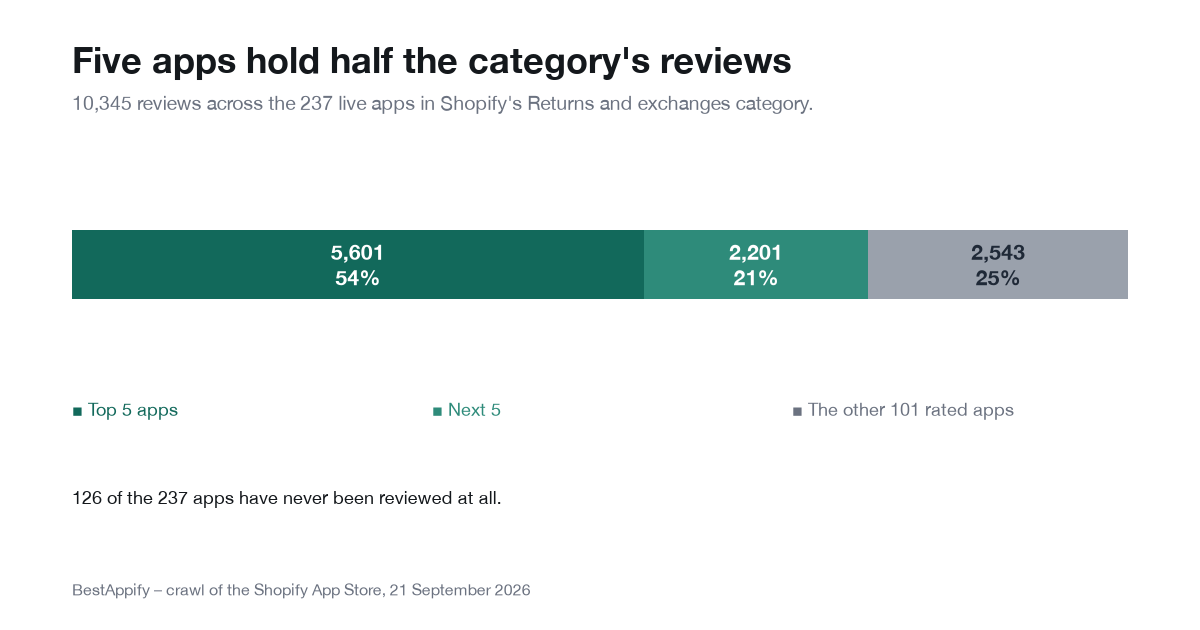
Half the category has never been reviewed. Of the 237 live apps, 126 have no reviews at all. Five apps hold 54% of the 10,345 reviews the whole category has earned. The real choice is between roughly fifteen products and a long tail you would be taking a risk on.
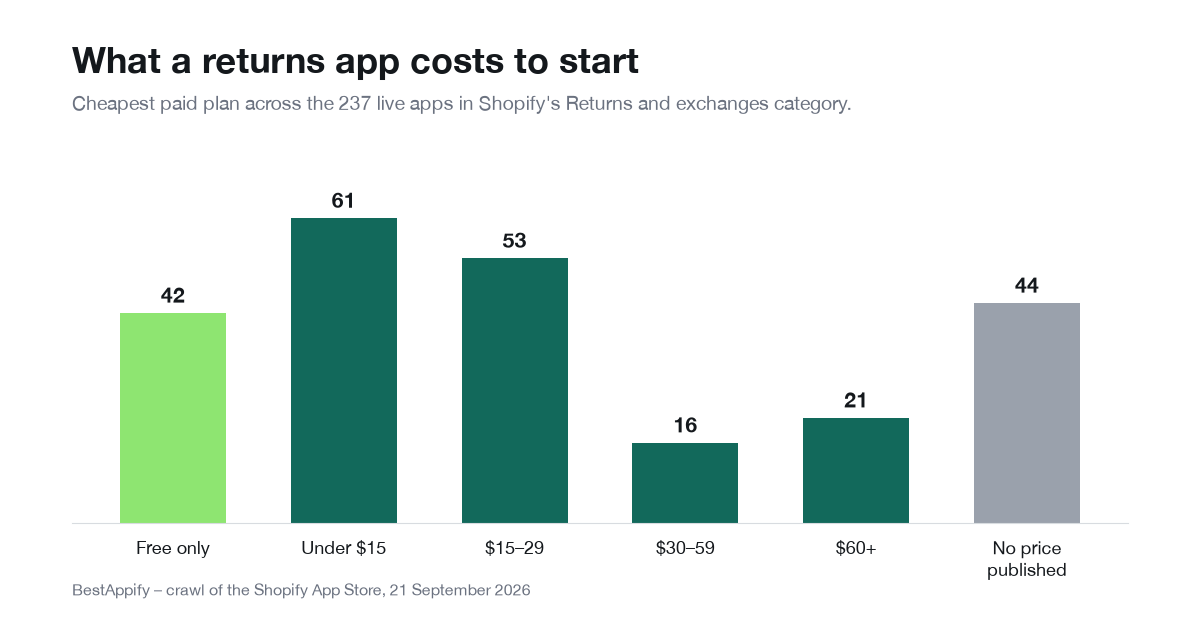
The price range is the widest we have measured in any category. Among the apps that publish a paid plan at all, the median cheapest one is $19 a month, but on the shortlist below the entry price runs from $4.99 to $179 — a 36x spread for products that describe the same job. Twenty-two per cent of the apps with published pricing have a top plan of $199 or more, and one runs to $1,124 a month.
Ratings will not separate them. The category mean is 4.82 and the median app shows a flat 5.0. Even after shrinking each rating toward the category average by how thin the evidence behind it is, the nineteen apps below sit between 4.62 and 4.93 — a third of a star apart, top to bottom. Treat any difference inside that band as noise. We have written about why Shopify app ratings compress like this before; the returns category is a textbook case.
The most-reviewed "returns" app is not a returns app. Three of the nineteen are German-language EU withdrawal-button widgets, and between them they hold 37% of the shortlist's ratings. They add a legally-worded withdrawal form to a store; they do not run a returns operation. Whether you need one is a question for your own legal advisor, not a returns-operations decision — and if you are not selling into the EU, ignore the top of the table entirely.
The shortlist
Nineteen apps clear the bar: the name promises returns, exchanges, refunds or withdrawal, and the listing carries at least 50 ratings. Everything in this table was read from the live App Store listing on 21 September 2026.
Eleven of the nineteen carry Shopify's Built for Shopify badge, which is the one quality signal on a listing that an app cannot award itself.
Pick the job, then the app
"Returns" covers four different products wearing one category badge. Installing the wrong one is the expensive mistake here, not picking the second-best app in the right one.
A self-serve returns portal — the default choice
The customer files the return themselves, the app issues a label and the request lands in a queue instead of your inbox. This is what AfterShip, CWILL, Synctrack, Yanet, Return Prime and ReturnZap do, and for most stores it is the whole job. AfterShip is the volume incumbent at 1,541 ratings; CWILL and Synctrack score higher here because both pair a comparable rating with a genuinely usable free tier and a $19–29 entry, where AfterShip's second tier jumps to $119.
If you are processing a handful of returns a week, start on a free plan and do not pay anything. Check what "free" means on the listing first — in this category it usually means a monthly cap on return requests, and the cap is where the bill starts.
Exchange-first, to keep the revenue
The one thing in this category that plausibly protects money rather than time: steering a refund into an exchange or store credit before the refund button is ever pressed. Loop built its business on it, ReturnGO and PostCo sell the same idea, and it is priced accordingly — $147 to $179 a month to start, roughly eight times the category median. That is a real decision, not a shrug: at a $30 average order value you need to convert a lot of refunds into exchanges before the app pays for itself. Work out the number before you install.
Loop is worth a note of its own. Its App Store rating is 4.6 — the lowest on this shortlist — while it is also the platform most brands in this space name first. That is what a big installed base does to a rating; it is not evidence the product is worse than a 4.9 with ninety ratings behind it.
Shipping protection, which is a different product
Guide Protection + Returns, and the protection apps Shopify also files in this category, are insurance on the parcel: they cover lost, stolen and damaged orders. Useful, and nothing at all to do with the returns your customers choose to make. Do not buy one expecting a returns portal.
EU withdrawal buttons, which are compliance
EU Withdrawal Button & Form, Revoq and Returns & EU Withdrawal-Button add a withdrawal form the listings tie to an EU requirement dated 2026. They are cheap ($9–10 to start), heavily reviewed, and they are a legal box, not an operations tool. If you sell into Germany you have probably already been told about these; if you do not, they are noise in your search results.
What actually goes wrong — from 94 angry reviews
We hold 2,317 crawled reviews for apps in this category. Ninety-four of them are one or two stars with text, and reading all ninety-four is more useful than any feature comparison, because the failures cluster.
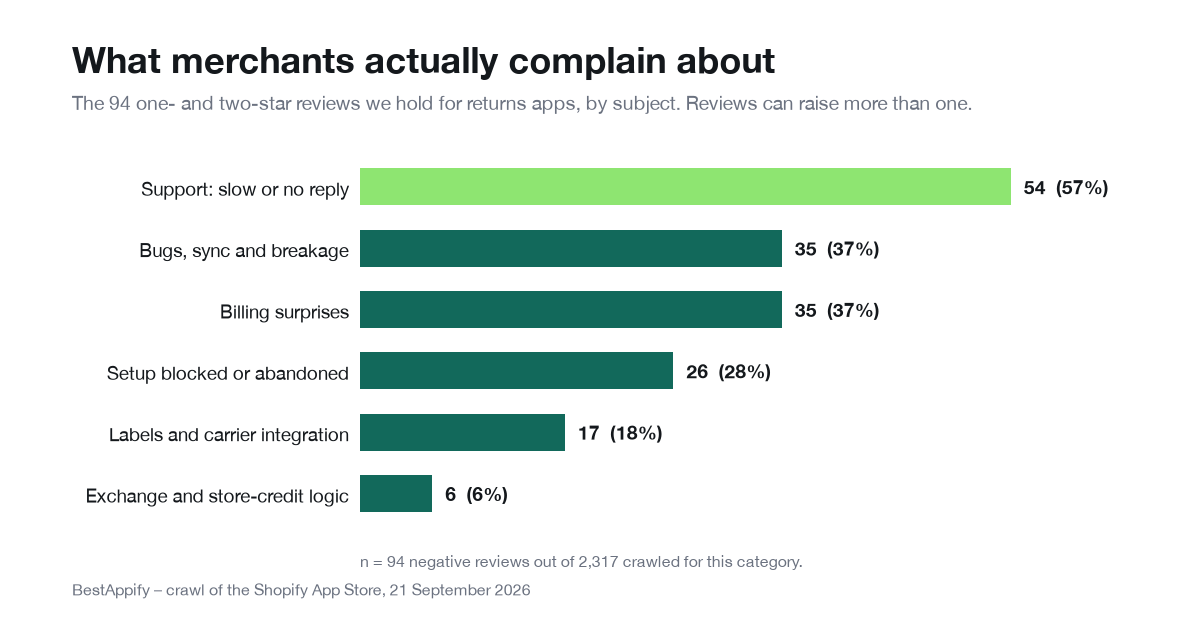
Support is the failure mode, not features. Fifty-four of the ninety-four negative reviews are about a reply that took days or never came. Not one of them is about a missing feature the merchant discovered on the pricing page. We found the same pattern across 2,797 bad reviews store-wide: merchants forgive missing features and do not forgive silence.
Billing surprises are the second theme (35 reviews): charges for labels the customer never used, a free plan that ended without warning, a per-return fee that only appears at volume. In a category where the product generates shipping labels on your account, read the label-cost terms before the feature list.
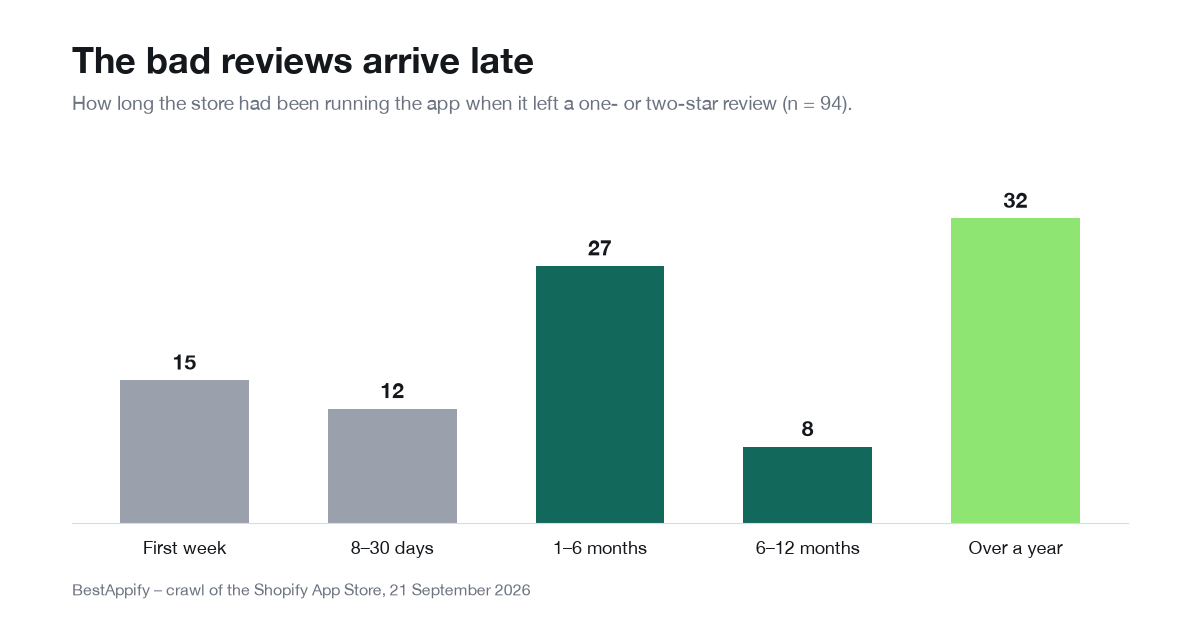
And the complaints arrive late. A third of them come from stores that had used the app for more than a year. That is the part a free trial cannot protect you from: the things that break in this category — a label cancelled while the parcel is in transit, an exchange priced at today's sale price instead of what the customer paid, a carrier integration that stops working after a platform update — are all month-four problems, not day-one problems.
So test the late failures on purpose
- Put a real return through end to end, including the label, and confirm what happens when the customer changes their mind after the label is generated. Who pays for it?
- Process one exchange for an item whose price has changed since the order. Several of the worst reviews in our set are exactly this.
- Find the cap on the free plan and the per-return fee above it before you migrate anything.
- Email support once with a real question and time the reply. It is the single most predictive thing you can measure in a trial, and in this category 41% of negative reviews get a public developer response against 20% of reviews overall — so also read how the vendor answers its one-star reviews on the listing.
The honest part: none of these reduce your return rate
Every app above processes returns. Processing a return faster and more cheaply is worth real money, and steering a refund into an exchange keeps revenue that would otherwise leave. But nothing in this category stops the customer ordering the wrong size.
The tools that plausibly do that sit in a different part of the App Store and cost a fraction as much. Across the 107 live apps whose name promises a size chart, size guide or size recommender, the median cheapest paid plan is $6.99 a month. The three biggest by adoption, read live on 21 September 2026:
| App | Rating | Ratings | Starts at |
|---|---|---|---|
| Kiwi Size Chart & Recommender | 4.7 | 1,211 | Free, then $7.99/mo |
| MP Size Chart & Size Guide | 5.0 | 867 | Free, then $6.95/mo |
| Smart Size Chart & Size Guide | 4.9 | 143 | Free, then $9/mo |
All three carry the Built for Shopify badge and all three have a free plan. We can measure what they cost and how many stores run them. We cannot measure whether they cut your return rate — nobody publishes that, and any article that quotes you a percentage for it made the number up. What we can say is that if apparel sizing is what drives your returns, a $7 app that prevents the order is a cheaper first experiment than a $155 platform that processes it afterwards.
How we scored these
Each shortlisted app gets a 0–100 score from three measurements, each ranked against the other eighteen: adoption (45%, rating count on a log scale, because it is the only public proxy for how many stores actually run the app), satisfaction (35%, the star rating shrunk toward the mean rating of the narrowed category, 4.81, in proportion to how few ratings back it, so a 5.0 on fifty-five does not outrank a 4.7 on fifteen hundred) and price (20%, a genuine free plan taking the top of the band).
Three honest limits. First, we dropped the momentum term we normally include — reviews gained and category-rank movement — because our daily capture of this category has only been stable for ten days, and a ten-day window cannot tell you which of these apps is growing. A window that means nothing is worse than no window. Second, the complaint analysis reads the 2,317 reviews we have crawled, not all 10,345 the category holds, and our crawl is deeper on some apps than others; treat the themes as a reliable picture of what goes wrong and not as a league table of which vendor goes wrong most. Third, the category is Shopify's, not ours: it mixes in shipping-protection, fulfilment and gift-card apps, so the shortlist is narrowed to apps whose own name promises returns, exchanges, refunds or withdrawal.
The score cannot tell you whether an app is good at its job. It reads no feature lists, installs nothing and talks to no merchants. Use it to get from 237 candidates to three, then install those three and run a real return through each. Our live scored ranking of the whole returns category updates weekly and applies no rating floor, so it will disagree with this table in places — that is the floor doing its job, not a contradiction.
Related reading: best Shopify apps for loyalty and rewards, best Shopify apps for raising average order value, and how many Shopify apps you should actually have.
Work at a returns app?
We sell one labelled placement per category page, and it sits outside the ranking — the table above is computed from the crawl and is not for sale at any price. If you build in this category and want the labelled slot, the packages and prices are on bestappify.com/advertise.