One app holds 49% of every review in a 432-app category, and 230 of those apps have never been rated themselves. We scored all of them on adoption, satisfaction, momentum and price — including why two of the biggest names finish outside the top five.
Best Shopify Apps for Collecting Product Reviews
Product reviews are the cheapest conversion work available to a Shopify store: the content is written by someone else, it never expires, and it does the persuading on the pages where people decide. The app that collects them is a small decision with a long tail — whichever one you pick, your reviews live inside it for years.
There are 432 review apps in Shopify's Product reviews chart. We crawl the App Store daily and scored all of them. Two things about this category make it different from every other one we have looked at, and both should change how you choose.
One app has half the category
Judge.me holds 43,566 merchant reviews. That is 49.1% of every review held by every app in the category — more than the next four apps put together, and more than the other 197 rated apps combined.
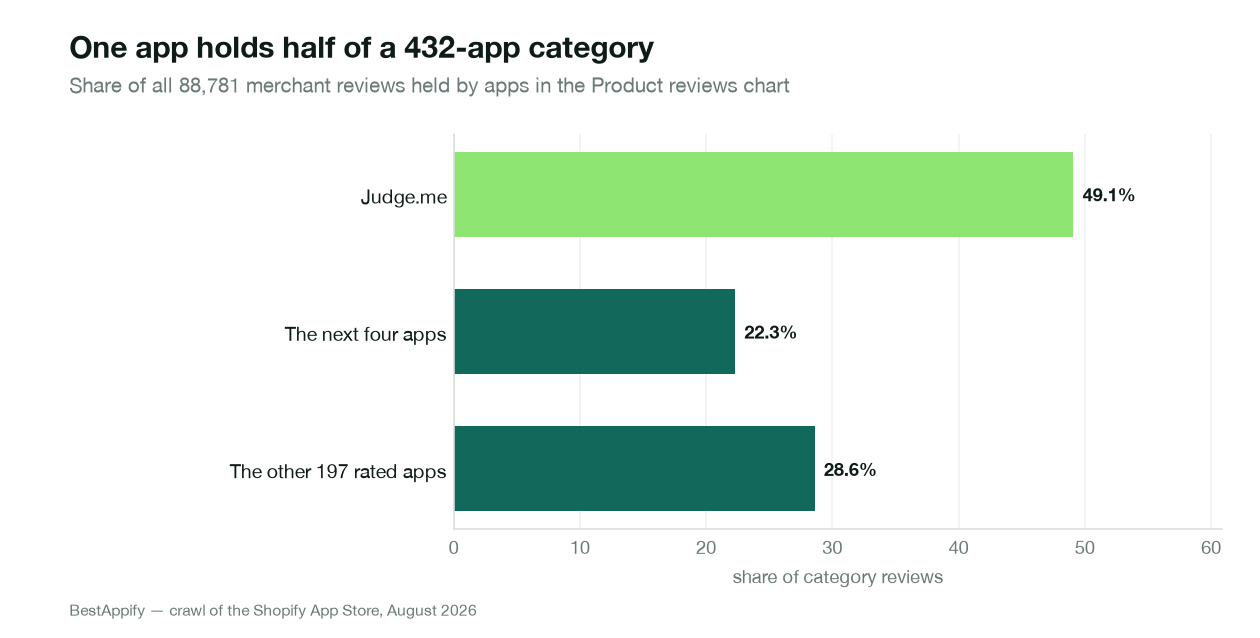
We have measured this shape across the store before: some categories are genuinely contested and some are settled, and roughly a third of Shopify categories are winner-take-all. Product reviews is one of the most concentrated of them. For a merchant that is useful information, not a warning. In a settled category the default is the default for a reason: the widest theme support, the most integrations, the most Stack Overflow answers when something breaks at 11pm.
More than half of these apps have never been reviewed
Of the 432 apps in the chart, 230 have no rating at all. Of the 202 that do, 139 have fewer than fifty reviews. Thirteen apps in the entire category have more than a thousand.
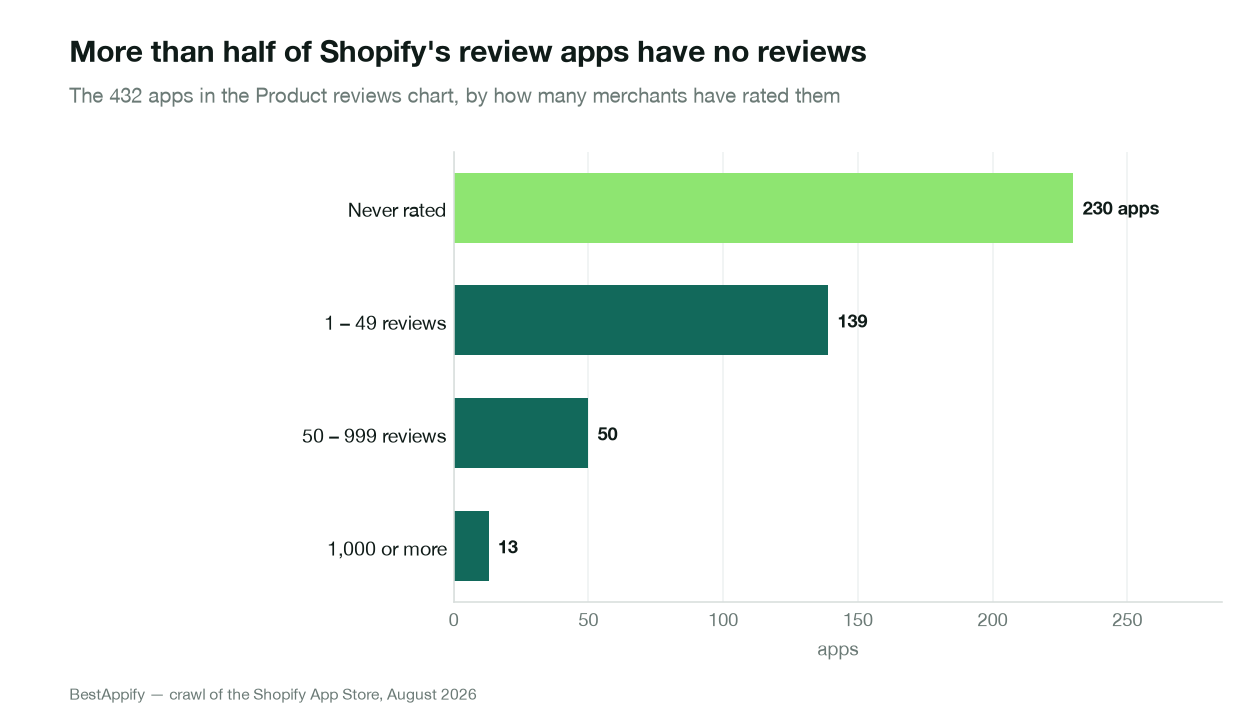
There is a joke in there — the review apps cannot get reviews — but the practical point is that "top rated review app" is a meaningless phrase here. An app showing 5.0 from four merchants tells you nothing, and this category is full of them. Our score handles that by pulling a rating toward the category average in proportion to how thin the evidence behind it is, which is why a 5.0 from three merchants finishes below a 4.9 from nine thousand.
The shortlist
| App | Score | Rating | Price | Best for |
|---|---|---|---|---|
| Judge.me Product Reviews | 96.8 | 5.0 (43,566) | Free, then $15/mo | The default, and it earns it |
| Google Reviews Rocket | 94.8 | 5.0 (549) | Free, then $4.99/mo | Pulling in your Google reviews |
| TrustShop: Product Reviews | 94.1 | 5.0 (339) | Free, then $9.90/mo | The cheap clean-record option |
| Loox — Product Reviews | 93.7 | 4.9 (8,997) | Free, then $49.99/mo | Photo and video reviews |
| Okendo: Reviews & Loyalty | 91.1 | 4.9 (1,317) | Free, then $19/mo | Reviews plus loyalty in one |
Judge.me is the one to install unless you have a specific reason not to. A real free plan, forty-three thousand merchants behind it, a clean 5.0, and it is still gaining reviews faster than anything else in the category at a size where most apps have plateaued. Very little on the App Store has this much evidence behind it.
Loox is the reason to deviate. It is built around photo and video reviews rather than text — a different product for a different catalogue, which is to say apparel, homeware, anything where the customer's own photo is the argument. 8,997 merchants at 4.9. Note the price step: the free plan is real, but the first paid tier is $49.99/month, more than three times Judge.me's. That is the one number on this page most likely to surprise you later.
Okendo bundles reviews with loyalty. Worth it if you were going to buy a loyalty app anyway; if you were not, you are paying for half a product you will not use.
Google Reviews Rocket and TrustShop score above Loox and Okendo here, and it is worth being clear about why, because the score is doing something deliberate. Both have spotless ratings, cheap paid tiers and strong recent growth — but 549 and 339 reviews against Judge.me's 43,566. Read them as "cheap, and nobody who used it complained", not as "better than Judge.me". They are the right shortlist entries for a small store that wants to spend $5 rather than $15; they are not the safe choice for a store betting two years of review collection on one vendor.
The big names, and why they score lower
Two apps you have probably heard of are missing from that table, and the reason is the most useful thing our data says about this category.
| App | Score | Adoption | Satisfaction | Momentum |
|---|---|---|---|---|
| Yotpo: Product Reviews | 78.6 | 99.5 | 49.8 | 69.2 |
| Stamped Reviews & Loyalty | 50.5 | 99.3 | 17.4 | 24.2 |
Both are enormous — 4,393 and 3,398 merchant reviews put them in the top five of the category by adoption, above everything except Judge.me and Loox. And both fall apart on satisfaction. Yotpo's 4.8 is the median rating in this category, not a good one. Stamped's 4.7 puts it in the bottom fifth, which sounds impossible until you see the distribution — we wrote about how a 4.7 rating puts a Shopify app in the bottom third of the store. Stamped also has the worst momentum of any large app here: it is losing ground in the category chart while the apps around it gain.
This is the whole argument for scoring rather than listing. Sort by brand recognition and Yotpo and Stamped are in your top five. Sort by rating alone and they still look fine, because 4.7 reads as a good number to anyone who has not seen what the rest of the store looks like. It takes putting adoption, satisfaction and direction of travel side by side for the gap to show.
The full ranked list, which updates weekly as the crawl moves: best Shopify product review apps.
The thing nobody tells you about review apps
Your reviews are portable in theory and painful in practice. Every app on this list will import a CSV, and every one of them stores photos, verified-buyer flags, replies and Q&A in its own shape. What survives an export is usually the star and the text; what does not is everything that made the reviews persuasive.
Reviews are also only half of the on-page argument. The other half is what the visitor puts in the basket once they are convinced, which is a different set of apps entirely — we scored those in best Shopify apps for raising average order value.
So the switching cost is not the monthly price, it is the year of collection you would repeat. Choose for where the store will be in two years, not for the free tier this month. That reasoning runs the other way too: if you are on a review app with four hundred reviews and it is working, "there is a slightly better one" is not a reason to move.
How we scored these
Each app gets a 0–100 BestAppify Score from four measurements, each ranked against the other apps in the same category: adoption (35%, review count on a log scale), satisfaction (30%, the rating shrunk toward the category average by how thin its evidence is), momentum (20%, reviews gained and category-rank movement), and price (15%, with a genuine free plan taking the top).
One honest limit specific to this category. Momentum here is measured over 16 days rather than the 52 we have for older categories, because our coverage of Product reviews only reached its current 436 listings on 9 August — before that we held 28 of them, and comparing a rank out of 28 to a rank out of 436 would show every established app collapsing when nothing had happened. A shorter window that means something beats a longer one that does not.
The score also cannot see whether an app is any good at its job. It reads no feature lists and installs nothing. Use it to get from 432 candidates to three.
Figures come from our crawl of the Shopify App Store in August 2026: 432 live listings in the Product reviews category chart, holding 88,781 merchant reviews between them.